Sunday, March 16, 2008

Haunted Histories: Insight into Bodie and Skidoo

Excerpts from the LA Times article by Hugo Martin. For full story click here.

Spirits of the West hang around ghost towns

The ghost towns of the American West recall a desperate era. Located on high plains and open deserts where sandstorms and cold winter nights embalm any semblance of life, these towns still whisper their legends to anyone willing to stop and listen.

You'll hear the stories of the men, the women and the children who abandoned their homes, gave up their mining claims and vanished.

Today, these ghost towns offer little more than dusty whiskey bottles on warped shelves, dog-eared hymnals in church pews and framed black-and-white photos, veiled in spiderwebs.

Skidoo, Calif.:
Pity the hard-luck residents of Skidoo, perhaps the sorriest little mining settlement in the West.

In its short-lived, miserable history, the town had the misfortune of attracting such desperate characters as Joe "Hooch" Simpson. In 1908, this down-on-his-luck barkeep made the mistake of gunning down the town banker for $20, and when a lynch mob finally got its hands on him, they couldn't wait to build a proper gallows. They hanged him from the telegraph pole that brought news of the outside world to this benighted patch of earth.

When a reporter from the Los Angeles Times showed up to take a photograph, the good citizens of Skidoo accommodated him by digging up Hooch, brushing him off and hanging him again. But then the town doctor, in a macabre moment, lopped off Hooch's head to test for syphilis, the possible cause of his sudden madness.

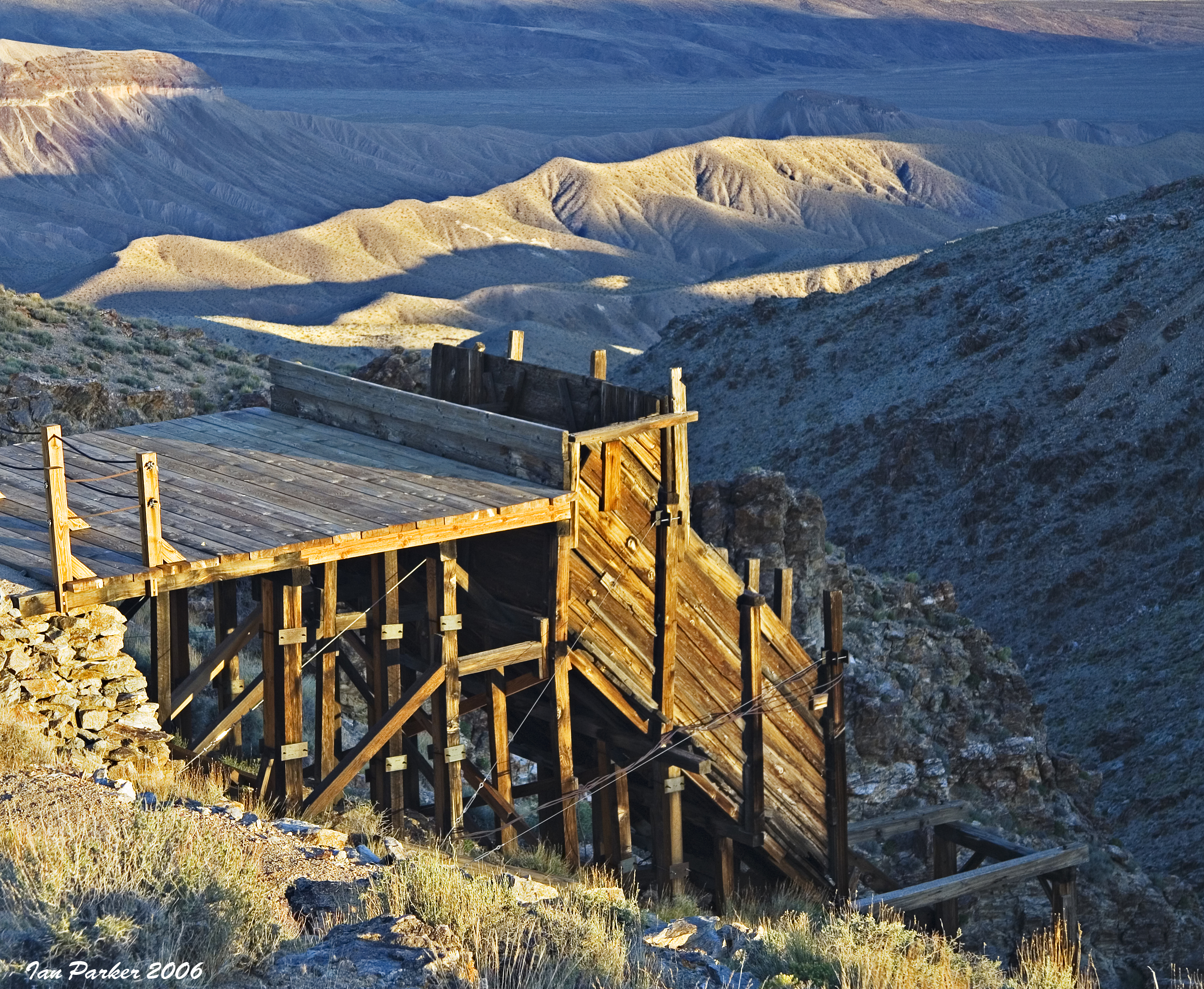
No wonder the twice-hanged, headless Hooch still wanders these empty hills in Death Valley where all that remains are a historical marker, broken bottles and hundreds of abandoned mine shafts.

Directions: From Stovepipe Wells, drive southwest along California Highway 190 for nine miles, turn left on Wildrose Canyon Road and, after nine more miles, turn left on the first major gravel road and continue for almost eight miles. For more information, call the Death Valley National Park at (760) 786-3200.
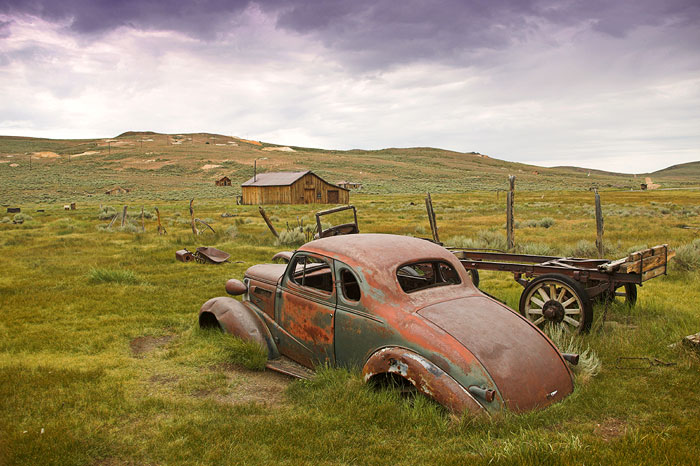
Bodie, Calif.: Bodie is a cursed ghost town. Pilfer anything from one of the old sun-bleached buildings north of Mono Lake -- a nail, part of a clock or even an old bottle -- and bad luck latches onto you forever.

Don't believe it? Then tell it to the visitors of this ghost town who have been returning stolen stuff with tales of heartbreak, death and serious injury that beset them once they left this Eastern Sierra settlement.

One fearful visitor even returned the nail that pierced her tire as she drove through town.

Directions: From U.S. Highway 395, take California Highway 270 east. Drive 10 miles to the end of the pavement and continue three miles on a dirt road. For more information, call Bodie State Historic Park, ( 760) 647-6445.

Sunday, February 24, 2008

BLUE SPIRITS: Published March 30, 1885 in the New York Times


The recent use of aniline blue in connection with spirit manifestations has been warmly received by the opponents of Spiritualism. A spirit that had emerged from the usual cabinet where the medium lay entranced was rudely sprinkled with aniline blue by a wicked skeptic. The spirit retreated to the cabinet, and on investigation it was found that the medium's cheek was dyed a deep blue.

From this coincidence the opponents of Spiritualism are now joyfully arguing that the alleged spirit was not a spirit at all, but only the medium disguised; and it is claimed that no medium will hereafter try to personate a spirit through fear that he will be dyed blue and his dishonesty thereby exposed.

It will, of course, be asserted by earnest Spiritualists that the mere fact that the medium was found with his cheek dyed proves nothing. As is well known, a spirit, in order to be visible, must clothe itself with material particles taken from the body of the medium, which particles are returned to their owner when the show--that is to say the manifestation--is over.

If a spirit meets with an accident while wearing the medium's body, and the body is thereby stained with blue or any other color, it is not the spirit's business to wash it before returning it. All bodies borrowed by spirits are at the risk of their owners, and the latter must expect that some little wear and tear will happen, especially in cases where a spirit finds a body a tight fit and bursts it out under the arms or across the back.

Still, it must be confessed that this argument will have little effect upon unbelievers, who will continue to maintain that if a medium shows the mark of aniline blue that has been sprinkled on an alleged spirit he is an impostor. This conviction cannot be removed by anything the Spiritualists can say, and mediums who are wise will take measures to avoid any possible future complications with aniline blue.

This can readily be done by permitting only blue spirits to materialize. We know on the authority of SHAKESPEARE that there are blue spirits, and it is plain that aniline blue would make no mark on them. Of course in order to provide blue spirits with a temporary blue body it would be necessary for the medium to paint himself blue. Were he to do this, and to exhibit only blue ghosts, the malice of the sprinklers of aniline blue would be brought to naught.

In case, however, any attempt should be made to dye blue spirits black or yellow it would be well for every spirit to carry a damp sponge in its pocket and to wipe away any coloring matter that wicked men might throw at it.

Sunday, February 17, 2008

THE FORGOTTEN: Abandoned Cemeteries of Route 66


They are tiny dots on internet maps and AAA guides, a speck that leads travelers to overlook them and focus on other destinations and big cities. Their names were well known 50, 75 years ago; Oro Grande, Ludlow, Amboy, Bagdad, Daggett, Helendale. Destinations and stops for weary travelers looking for food, water, rest and a break from the miles of empty roadway behind them. As an occasional vehicle or train passes by, some permanent residents have also been passed by, left to vandals, the elements, virtually all but forgotten in Route 66 cemeteries.

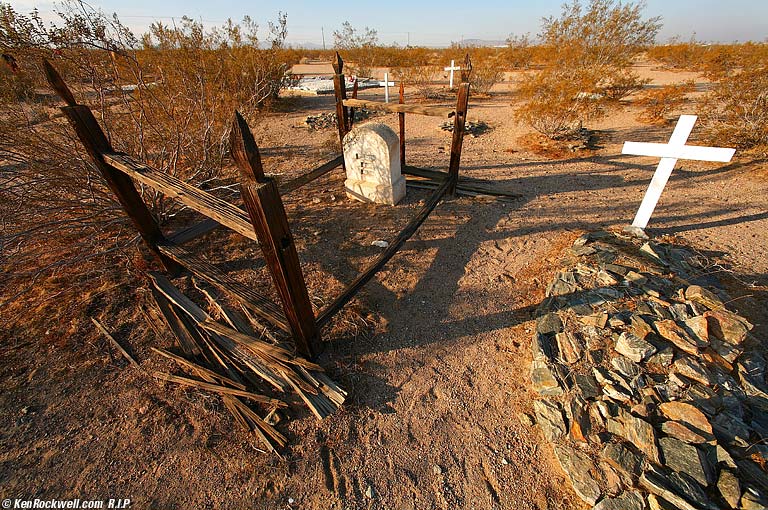
The Mother Road's cemeteries lay in a state of disrepair. Located on lonely hillsides, out of sight of the few cars that still travel the legendary road; they are the final resting place for those who came West, searching for a better life. Broken gates, dangling barbwire, and tilted wooden crosses are the first signs of our National Trails Highway cemeteries demise!

For those who found their resting place in roadside towns like Amboy, just outside of town, still within sight of the Roy's sign, lay the remains of several dozen souls. A weather beaten flag pole and slivers of a tattered American flag stand watch over the graves. Rows of hand made wooden crosses mark the graves of the town's former residents and visitors. A few have had stone placed in a circle over them, others are simply mounds of dirt and rock marking the grave.

But Amboy is but one of many, in need of a savior, a community, a government willing to step up and protect their hallowed grounds. The dedication of people like Albert Okura (who owns the Juan Pollo restaurant chain and Amboy) may be able to protect its forgotten graveyard. Amboy is one of the best known stops along The Mother Road and Mr. Okura is fighting an inspiring battle to restore this unique and historical stop back to its former glory.

Travel to Oro Grande and a search will lead you to a quiet hillside, within sight of the towns cement plant. There residents have fought a valiant battle to preserve the cemetery. Vigilant folks have had to endure hoodlums, cultists, the elements and even battled the cement plant to protect the resting place of loved ones. Wooden crosses and stone circles on top of shifting sand, mark the location of Oro Grande's graves, a few vandalized tombstones stand in defiance of the dreadful conditions inflicted on them over the years. Rumors of the cemetery being haunted have drawn the curious, the intoxicated, the bizarre and a few who have intentionally damaged tombstones.

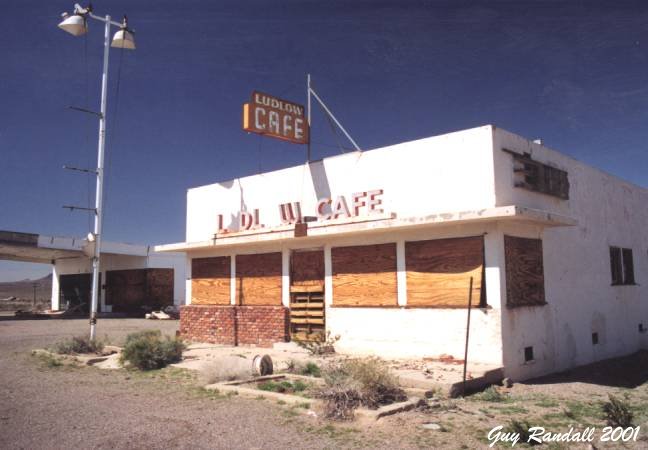
Between Oro Grande and Amboy along Route 66 is Ludlow which continues to cling to existence thanks to its location. But besides stopping for gas, Ludlow does not call travelers to explore it. Abandoned buildings, crumbling adobe and stone walls and an earthquake damaged store stand in testament to a former life. Beyond the buildings, beyond the tracks, lies Ludlow's cemetery. Sagebrush and trees have found their way into the cemetery, often overtaking a grave with roots, trash and debris dangle from its branches. How many lay in rest here, thousands of miles from their home, their family?


Beyond the road, the railroad tracks, revealed only to the diligent searcher, lay Bagdad's cemetery. For those who found their resting place in this out-of-the-way patch of desert, isolation has been both a blessing and a curse. For Bagdad, even remoteness and the Penal Code has done little to prevent grave robbers from attempting to dig up the remains of these forgotten souls. Tattered cloth mix with sage brush, in a 4 foot hole where a grave was desecrated, leaving one to ponder in this inhospitable place, if the victim lay there exposed? A few stones, cans and makeshift crosses are all that cling to a dying effort to mark these graves.

For Route 66 cemeteries, their existence is also a convenient memory loss for those responsible for their care. Both the State Cemetery and Funeral Bureau and the San Bernardino County Board of Supervisors seem oblivious to these resting places. Even though California's Health and Safety Code, place their care, management and supervision under the control of County Government, no time is given, no money is spent to protect and care for Route 66 graveyards.

Poignant questions that are left to the readers, concerned citizens and our elected officials to answer. The dead have no voice, except ours. Who will speak for them?

Ron Paschall
P.O. Box 7076
Redlands, CA 92375
(909) 798-7977


Sunday, February 3, 2008

Ghost of the Week: The Woman in the Tower

GHOULA EXCLUSIVE!

The Beverly Wilshire Hotel is easily the most iconic piece of architecture in Beverly Hills. Its exterior is even used in movies such as Pretty Woman and Beverly Hills Cop as a symbol for the city itself, much like the Eiffel Tower is to Paris or Big Ben is to London. This Historic Hotel’s reputation is built on that very perception.

But, is it haunted? If you ask the management, they will tell you it’s definitely not. However, if you can talk privately with any member of their housekeeping staff, you will get the truth. The Beverly Wilshire has two very prominent ghosts occupying different ends of the hotel.

Residing on the eighth floor of the Wilshire Tower section, you’ll find a female apparition with long flowing blond hair. She has been seen on numerous occasions gracefully gliding about with her white gown billowing behind her. Some witnesses have even spotted her peeking out from around corners or poking her head out through open doors as if curious about her surroundings.

While the hotel was built in 1928, it appears this blond ghost is a very recent addition. It is because of this, many of the employees believe she is the spirit of a woman who died a few years ago, but lived most of her life in a posh suite on the eighth floor. Since her passing, that suite has been closed to the general public, and is currently only available for private VIVIP (very important VIP) parties. Is it these disturbances to her tranquil domain that cause the spiritual disturbance on the eighth floor? Again, don’t ask the management.

The Beverly Wilshire Hotel is located at 9500 Wilshire Blvd, Beverly Hills. As for the other prominent ghost… stay tuned. It will be featured in a future “Ghost of the Week.”