Sunday, February 17, 2008

THE FORGOTTEN: Abandoned Cemeteries of Route 66


They are tiny dots on internet maps and AAA guides, a speck that leads travelers to overlook them and focus on other destinations and big cities. Their names were well known 50, 75 years ago; Oro Grande, Ludlow, Amboy, Bagdad, Daggett, Helendale. Destinations and stops for weary travelers looking for food, water, rest and a break from the miles of empty roadway behind them. As an occasional vehicle or train passes by, some permanent residents have also been passed by, left to vandals, the elements, virtually all but forgotten in Route 66 cemeteries.

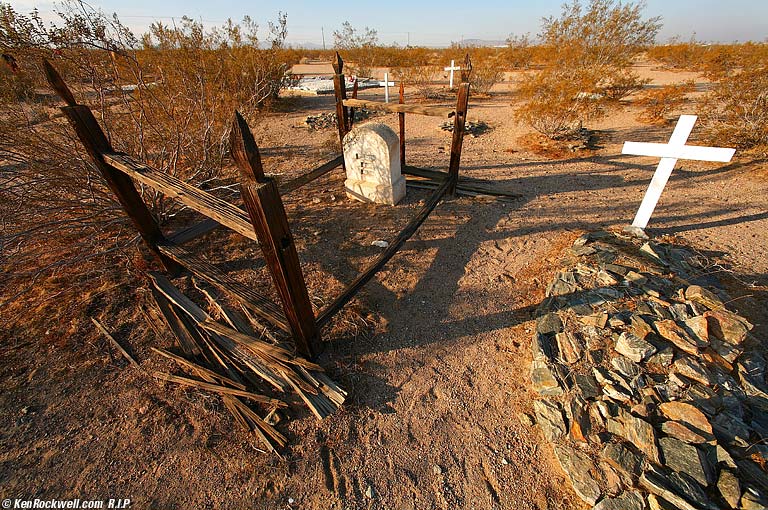
The Mother Road's cemeteries lay in a state of disrepair. Located on lonely hillsides, out of sight of the few cars that still travel the legendary road; they are the final resting place for those who came West, searching for a better life. Broken gates, dangling barbwire, and tilted wooden crosses are the first signs of our National Trails Highway cemeteries demise!

For those who found their resting place in roadside towns like Amboy, just outside of town, still within sight of the Roy's sign, lay the remains of several dozen souls. A weather beaten flag pole and slivers of a tattered American flag stand watch over the graves. Rows of hand made wooden crosses mark the graves of the town's former residents and visitors. A few have had stone placed in a circle over them, others are simply mounds of dirt and rock marking the grave.

But Amboy is but one of many, in need of a savior, a community, a government willing to step up and protect their hallowed grounds. The dedication of people like Albert Okura (who owns the Juan Pollo restaurant chain and Amboy) may be able to protect its forgotten graveyard. Amboy is one of the best known stops along The Mother Road and Mr. Okura is fighting an inspiring battle to restore this unique and historical stop back to its former glory.

Travel to Oro Grande and a search will lead you to a quiet hillside, within sight of the towns cement plant. There residents have fought a valiant battle to preserve the cemetery. Vigilant folks have had to endure hoodlums, cultists, the elements and even battled the cement plant to protect the resting place of loved ones. Wooden crosses and stone circles on top of shifting sand, mark the location of Oro Grande's graves, a few vandalized tombstones stand in defiance of the dreadful conditions inflicted on them over the years. Rumors of the cemetery being haunted have drawn the curious, the intoxicated, the bizarre and a few who have intentionally damaged tombstones.

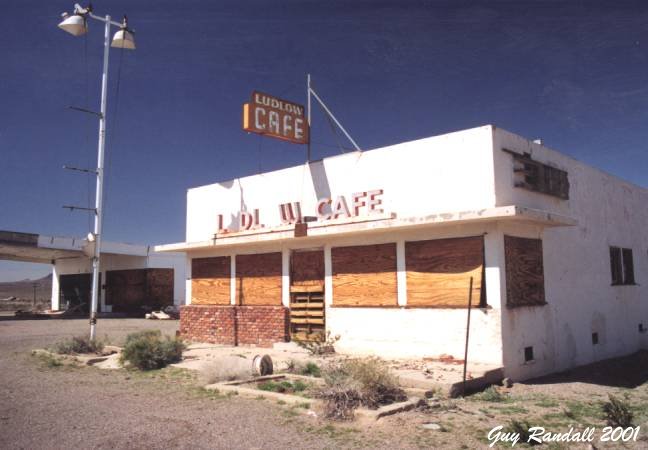
Between Oro Grande and Amboy along Route 66 is Ludlow which continues to cling to existence thanks to its location. But besides stopping for gas, Ludlow does not call travelers to explore it. Abandoned buildings, crumbling adobe and stone walls and an earthquake damaged store stand in testament to a former life. Beyond the buildings, beyond the tracks, lies Ludlow's cemetery. Sagebrush and trees have found their way into the cemetery, often overtaking a grave with roots, trash and debris dangle from its branches. How many lay in rest here, thousands of miles from their home, their family?

Beyond the road, the railroad tracks, revealed only to the diligent searcher, lay Bagdad's cemetery. For those who found their resting place in this out-of-the-way patch of desert, isolation has been both a blessing and a curse. For Bagdad, even remoteness and the Penal Code has done little to prevent grave robbers from attempting to dig up the remains of these forgotten souls. Tattered cloth mix with sage brush, in a 4 foot hole where a grave was desecrated, leaving one to ponder in this inhospitable place, if the victim lay there exposed? A few stones, cans and makeshift crosses are all that cling to a dying effort to mark these graves.

For Route 66 cemeteries, their existence is also a convenient memory loss for those responsible for their care. Both the State Cemetery and Funeral Bureau and the San Bernardino County Board of Supervisors seem oblivious to these resting places. Even though California's Health and Safety Code, place their care, management and supervision under the control of County Government, no time is given, no money is spent to protect and care for Route 66 graveyards.

Poignant questions that are left to the readers, concerned citizens and our elected officials to answer. The dead have no voice, except ours. Who will speak for them?

Ron Paschall
P.O. Box 7076
Redlands, CA 92375
(909) 798-7977


Sunday, February 3, 2008

Ghost of the Week: The Woman in the Tower

GHOULA EXCLUSIVE!

The Beverly Wilshire Hotel is easily the most iconic piece of architecture in Beverly Hills. Its exterior is even used in movies such as Pretty Woman and Beverly Hills Cop as a symbol for the city itself, much like the Eiffel Tower is to Paris or Big Ben is to London. This Historic Hotel’s reputation is built on that very perception.

But, is it haunted? If you ask the management, they will tell you it’s definitely not. However, if you can talk privately with any member of their housekeeping staff, you will get the truth. The Beverly Wilshire has two very prominent ghosts occupying different ends of the hotel.

Residing on the eighth floor of the Wilshire Tower section, you’ll find a female apparition with long flowing blond hair. She has been seen on numerous occasions gracefully gliding about with her white gown billowing behind her. Some witnesses have even spotted her peeking out from around corners or poking her head out through open doors as if curious about her surroundings.

While the hotel was built in 1928, it appears this blond ghost is a very recent addition. It is because of this, many of the employees believe she is the spirit of a woman who died a few years ago, but lived most of her life in a posh suite on the eighth floor. Since her passing, that suite has been closed to the general public, and is currently only available for private VIVIP (very important VIP) parties. Is it these disturbances to her tranquil domain that cause the spiritual disturbance on the eighth floor? Again, don’t ask the management.

The Beverly Wilshire Hotel is located at 9500 Wilshire Blvd, Beverly Hills. As for the other prominent ghost… stay tuned. It will be featured in a future “Ghost of the Week.”

Wednesday, January 30, 2008

Ghost of the Week: Abbot Kinney Haunts Own Street

Tourists come from all over the world to Venice, California see all the colorful characters and eccentric artists that populate (and perform in) this area. So, a man strolling down the street dressed in Victorian formal-wear (complete with top hat, cape and cane) will generally not get a second look from the locals. It’s only when that man vanishes into thin air that the double takes begin.

Such is the case on Abbot Kinney Boulevard, between Venice and Main, where for at least the past three decades this strange phenomenon has been witnessed. Although this ghost’s identity is not known for certain, it is commonly believed to be the spirit of Abbot Kinney, himself.

Why this wealthy real estate developer from the turn of the last century strolls through that neighborhood is also unknown. In life, Kinney designed and built Venice as a themed resort destination for the wealthy, and a center for the arts in California, which is exactly what it became in the 1920’s, when silent movie stars made it their playground.

However, when the movie stars moved on, it became just another sleepy beach community, and eventually became incorporated into the City of Los Angeles. It was at this time that many of the canals where paved over and much of the Italian architecture destroyed. Perhaps, Abbot Kinney’s restless ghost wanders the streets because his most famous achievement in life did not come to fruition as he had intended.

Monday, January 14, 2008

Ghost of the Week: The King of Calabassas

Today, the Leonis Adobe is part of a park that is open to the public, where school children and curious locals go to get a glimpse of what life was like in the San Fernando Valley of the 1800’s. It is a peaceful oasis filled with rustic charm, where one can relax and daydream about the romantic early days of California. However, the truth surrounding this historic house is more the stuff of nightmares. 150 years ago, the area was very different indeed.

The Adobe was home to one of the most hated men in Los Angeles’ history, the tyrannical Miguel Leonis, who ruled most of the western valley with an iron fist, killing anyone who came close to his property. Much blood was spilt protecting this land, some of which he didn’t actually own. Given Miguel Leonis’ larger than life ferocity, it’s no wonder that only a few years after his death in 1889, ghost stories concerning this highly feared man began to surface. Apparently, to this day, even in death, he still watches over his property, making his presence known to those he feels shouldn’t be there. Visitors have experienced a wide gambit of manifestations (his figure, his footsteps, his voice, and even his touch), making the Leonis Adobe a tempting place for local ghost hunters.

The Leonis Adobe is located at 23537 Calabasas Road.